
The Big 3: Essential Stretches for Bilateral Lower Back Pain Relief

Updated: May 6
Visit Hadl Clinical Bodywork for Expert Assessment Schedule
https://www.hadlcenter.com/category/all-products PDF REHAB WORKOUTS
If you are experiencing bilateral lower back pain—aching on both sides of your spine simultaneously—the culprit is rarely the back itself. More often, it’s a "tug-of-war" happening in your hips. When your Psoas, Gluteus Medius, and Tensor Fasciae Latae (TFL) become chronically tight, they tilt your pelvis and force your lower back muscles to work overtime.
To find lasting relief, you must address these three specific areas. Here is the most effective routine to decompress your spine and restore hip mobility.
1. The Psoas: Releasing the Deep Core
The Psoas is the only muscle that connects your spine to your legs. When it’s tight (common in those who sit often), it pulls your lower vertebrae forward.
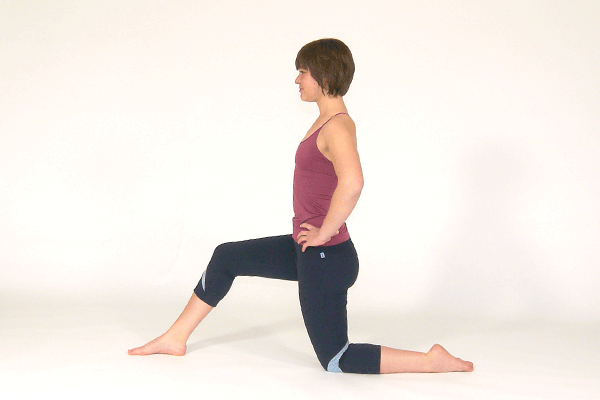
The Stretch: The Half-Kneeling Hip Flexor Stretch.
How to do it: Kneel on one knee (use a cushion). Tuck your tailbone under—this is the most important part—and gently shift your weight forward until you feel a deep stretch in the front of your hip.
Pro Tip: Reach the arm on the kneeling side up and slightly over to the opposite side to deepen the release.
2. Gluteus Medius: Stabilizing the Pelvis
The Glute Medius sits on the side of your hip. If it’s tight on both sides, it creates a "clamped" sensation in the sacroiliac (SI) joints.
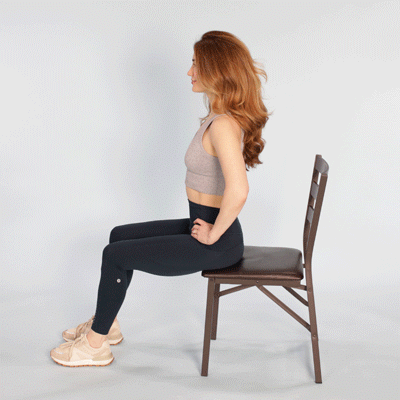
The Stretch: Seated Figure-Four.
How to do it: While sitting in a chair, cross your right ankle over your left knee. Keep your back straight (don't slouch!) and gently lean your chest forward.
Why it works: This opens the lateral hip, reducing the "pull" on the lateral aspects of your lower back.
3. Tensor Fasciae Latae (TFL): The "Pocket" Muscle
The TFL is a small muscle on the front-side of your hip that transitions into the IT band. A tight TFL creates internal rotation of the hip, which is a major contributor to bilateral back strain.
The Stretch: The Standing TFL Cross-Over.

How to do it: Stand near a wall for balance. Cross your right leg behind your left. Shift your right hip out to the side while leaning your upper body to the left.
The Sensation: You should feel this right where a "jean pocket" would be.
Why Bilateral Pain Requires a Holistic Approach
Stretching is only one piece of the puzzle that you can do on your own to address it. Bilateral pain often indicates systemic tension or postural habits that need professional assessment.
At Hadl Clinical Bodywork, we specialize in identifying these mechanical imbalances and trigger points to provide long-term relief rather than just a temporary fix.
Fort Worth Masage Therapy Experts 76107
Pre-designed Rehab programs
Hadl Clinical Bodywork
3600 Hulen Street suite B1
Fort Worth, Texas 76107
Sports Massage Specialists in Fort Worth
Medical Massage Experts in Fort Worth
Lymphatic Drainage Massage in Fort Worth
Athletic Stretching in Fort Worth
Cupping massage in Fort Worth
Sports injury massage in Fort Worth


Comments